

3D Projector Market Industry Forecast: From USD 4.53 Billion in 2025 to USD 8.32 Billion by 2035
3D Projector Market
3D Projector Market Size, Share and Research Report By Technology (Digital Light Processing (DLP), Liquid Crystal Display LCD, Liquid Crystal on Silicon (LCoS)
3D Projector Market is expanding as immersive visualization gains traction across entertainment, education, advertising, and commercial applications.”
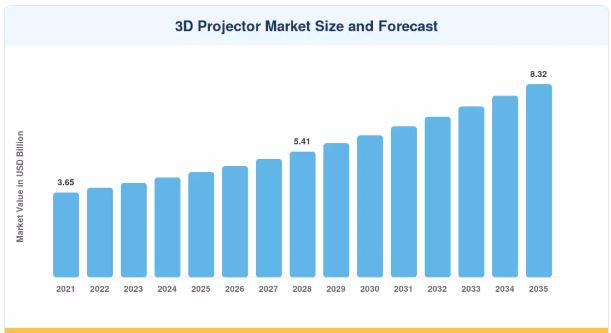
TOKYO, TOKYO, JAPAN, August 25, 2026 /EINPresswire.com/ -- The Global 3D projector market reached an estimated USD 4.53 billion in 2025 and is projected to grow from USD 4.79 billion in 2026 to USD 8.32 billion by 2035, registering a CAGR of 6.32% during the forecast period. Two major catalysts are accelerating this trajectory: the rapid adoption of active and passive 3D projection technologies across digital cinema, immersive entertainment, and simulation-based training environments, and the surge in demand for stereoscopic visualization tools within the healthcare imaging, engineering design, and geospatial analytics sectors. With global spending on immersive display infrastructure projected to exceed USD 980 billion through 2035, enterprises, academic institutions, and entertainment operators face mounting pressure to integrate 3D projection capabilities or concede competitive ground to rivals deploying next-generation spatial visualization platforms.— Market Research Future (MRFR)
Legacy 2D projection installations many anchored to flat-panel workflows and conventional lamp-based engines are rapidly giving way to laser-illuminated 3D platforms that integrate high-frame-rate (HFR) processing, active shutter synchronization, and passive polarization optics. A recent AVIXA global AV industry survey estimated that top-quartile AV integrators deploying 3D laser projection alongside immersive content management systems achieved 21–26% greater audience engagement metrics than peers still operating conventional 2D display environments. This technology transition is not incremental it represents a fundamental re-architecture of how the global display industry delivers spatial and volumetric visual experiences.
Get Full PDF Sample Copy of Report: (Including Full TOC, List of Tables & Figures, Chart) @
https://www.marketresearchfuture.com/sample_request/31469
➤ How Significant Is the 3D Projector Market’s Growth?
The 3D projector market has demonstrated consistent and robust expansion, rising from approximately USD 2.48 billion in 2021 to an estimated USD 4.53 billion in 2025, representing a compelling historical growth trajectory. The market is expected to more than double over the next decade, driven by expanding deployment across digital cinema multiplexes, theme park attractions, military simulation centers, medical visualization suites, and higher-education STEM laboratories each demanding increasingly sophisticated stereoscopic imaging fidelity.
Growing demand for high-resolution stereoscopic imagery in engineering CAD visualization, oil & gas reservoir modeling, neurosurgical planning, and live esports event production has created acute demand for advanced 3D projection platforms. Defense contractors, aerospace simulation vendors, surgical training institutes, and global entertainment operators are all investing heavily in next-generation 3D projection infrastructure to reduce cognitive load, enhance decision-making accuracy, and deliver differentiated audience experiences that flat-panel technologies cannot replicate.
➤ What Does the Future Hold for the 3D Projector Market?
Laser illumination combined with high-frame-rate 3D processing stands at the forefront of the market’s next growth phase. Solid-state laser-3D platforms are transforming stereoscopic projection from a lamp-dependent, high-maintenance operation into a sustainable, long-life display ecosystem. Leading RGB laser engines now support simultaneous left-eye/right-eye frame delivery at up to 240Hz per eye enabling flicker-free, ghost-free 3D imagery for both passive cinema and active shutter professional applications.
The growing convergence of 3D projection with extended reality (XR) and spatial computing environments is another defining force shaping the market’s future. Enterprise customers are increasingly integrating 3D projectors into mixed-reality workflows where large-format stereoscopic projection complements head-mounted displays (HMDs) for group training, collaborative design review, and immersive data visualization. Platforms supporting real-time 3D rendering feeds from Unreal Engine, NVIDIA Omniverse, and Unity are displacing static-content 3D setups in professional simulation and visualization markets.
Miniaturization and portability are also expanding the addressable market. Ultra-compact laser 3D pico-projectors and short-throw 3D systems are enabling mobile simulation, field training, and pop-up immersive entertainment applications that were previously constrained to fixed-installation environments. This democratization of 3D projection capability is expected to unlock substantial new demand from SME-scale production houses, independent event organizers, and emerging-market educational institutions.
Direct Purchase this Research Report:
https://www.marketresearchfuture.com/checkout?currency=one_user-USD&report_id=31469
➤ Who Are the Key Players in the 3D Projector Market?
The 3D projector landscape is characterized by a mix of established AV equipment manufacturers, specialized simulation technology vendors, and emerging immersive experience integrators. Key participants shaping the competitive dynamics include:
Barco — delivering industry-leading dual-laser 3D projection systems for digital cinema, simulation domes, and large-venue immersive installations
Christie Digital Systems — offering high-brightness 3D laser projectors for cinema, command visualization, and themed entertainment environments
Sony Electronics — providing 4K SXRD and DLP 3D projection platforms for premium cinema and professional visualization applications
NEC Display Solutions (Sharp NEC) — supplying enterprise-grade 3D installation projectors with advanced active stereo synchronization capabilities
Panasonic Connect — delivering professional 3D laser projection systems for large venues, live events, and simulation installations
Optoma Corporation — specializing in compact and mid-range 3D DLP projectors for education, corporate, and home cinema applications
BenQ Corporation — serving education and business segments with DLP-based Full HD and 4K 3D projection platforms
Digital Projection International — focusing on ultra-high-brightness 3D laser projectors for simulation, visualization, and themed entertainment
Epson — competing across 3D home cinema and entry-level professional segments with 3LCD-based stereoscopic projection systems
Volfoni — specializing in active and passive 3D synchronization systems, eyewear, and enabling technologies for cinema and enterprise 3D deployments
Competition in the market is intensifying as vendors race to embed real-time 3D rendering pipeline support, expand laser-illuminated 3D lineups across all brightness categories, and deepen integrations with spatial computing platforms, virtual production LED volumes, and immersive experience design ecosystems. Strategic partnerships with XR software developers, cinema content distributors, and defense simulation prime contractors are fundamentally reshaping the vendor competitive landscape.
➤ What Are the Emerging Trends in the 3D Projector Market?
Several transformational trends are redefining how the 3D projector market evolves through 2035:
Laser-Illuminated 3D Dominance: Solid-state RGB laser and laser phosphor engines are displacing lamp-based 3D systems, offering superior color volume, 20,000+ hour operational lifespans, and dramatically reduced total cost of ownership across all professional and cinema-grade lumen categories.
XR and Spatial Computing Integration: 3D projectors are increasingly integrated into extended reality workflows complementing HMDs in group training simulations, collaborative engineering reviews, and immersive data visualization environments served by platforms like NVIDIA Omniverse and Epic Unreal Engine.
High-Frame-Rate (HFR) 3D Adoption: Cinema and entertainment operators are investing in HFR 3D systems capable of 60–120fps per eye, eliminating motion blur and judder artifacts that historically limited stereoscopic immersion quality in fast-motion content.
Active vs. Passive 3D Technology Evolution: While passive polarization systems continue to dominate multiplex cinema installations, active shutter 3D technology is gaining renewed traction in professional simulation, surgical training, and engineering visualization where per-viewer optical control is essential.
Miniaturization and Portable 3D Systems: Compact laser 3D pico-projectors and short-throw systems are enabling mobile and pop-up immersive applications in field training, event production, and emerging-market education broadening the addressable market beyond traditional fixed-installation segments.
AI-Enhanced Depth Processing: AI-powered 2D-to-3D conversion engines, automated depth map generation, and real-time stereoscopic geometry correction are becoming standard features in premium 3D projectors dramatically expanding the volume of compatible content and reducing barriers to deployment.
Get access to the full description of the report @
https://www.marketresearchfuture.com/reports/3d-projector-market-31469
➤ How Is the 3D Projector Market Segmented?
The 3D projector market report provides a comprehensive segmentation framework:
1 By Technology: Active Shutter 3D, Passive Polarization 3D, Auto-Stereoscopic (Glasses-Free)
2 By Light Source: Lamp-Based, Laser Phosphor, RGB Laser, LED
3 By Resolution: Full HD (1080p), 4K UHD, 8K
4 By End-Use Vertical: Digital Cinema, Education & Research, Corporate & Enterprise, Healthcare & Medical Imaging, Defense & Simulation, Entertainment & Theme Parks
5 By Sales Channel: Direct Sales, AV Distributors & Integrators, Online Retail, Rental & Staging
➤ What Are the Regional Insights from the 3D Projector Market?
North America commands approximately 36% of global 3D projector market share, underpinned by the region’s advanced digital cinema infrastructure, large-scale defense simulation programs, and substantial investments in enterprise visualization and immersive training platforms. The U.S. remains the single largest national market, driven by the density of multiplex cinema screens, aerospace simulation centers, and surgical training facilities requiring stereoscopic projection capabilities.
Europe holds the second-largest share at approximately 28%, with Germany, the United Kingdom, and France serving as the primary markets. Europe’s strong automotive engineering design sector, expanding themed entertainment industry, and government investments in immersive STEM education infrastructure are primary demand drivers. Sustainability mandates are accelerating the transition from lamp-based to laser-illuminated 3D systems across institutional and commercial buyers throughout the region.
Asia-Pacific represents the fastest-growing major region, driven by booming multiplex cinema screen additions in China and India, expanding simulation and defense training investment across Southeast Asia, and a rapidly maturing immersive entertainment market in Japan, South Korea, and Australia. Government-backed smart campus and STEM education programs across the APAC region are expected to generate particularly strong demand for education-segment 3D projectors through 2030.
Middle East & Africa is projected to register the highest CAGR at approximately 8.6% through 2035. Transformational entertainment, tourism, and giga-project investments across Saudi Arabia (NEOM, Qiddiya, Red Sea Project) and the UAE are generating unprecedented demand for high-brightness 3D projection in theme parks, visitor experiences, and cultural institutions. Africa’s expanding higher-education sector is also driving entry-level 3D projector procurement across the continent.
South America rounds out the global picture, with Brazil and Mexico representing the most active markets for 3D projector procurement, particularly within the cinema exhibition, government defense, and higher-education verticals.
➤➤➤ Industry Analysis Reports by Market Research Future:
Blockchain In Fintech Market-
https://www.marketresearchfuture.com/reports/blockchain-fintech-market-6368
Alcohol Sensor Market-
https://www.marketresearchfuture.com/reports/alcohol-sensor-market-6451
Fuel Card Market-
https://www.marketresearchfuture.com/reports/fuel-card-market-6688
Collaborative Robots Market-
https://www.marketresearchfuture.com/reports/collaborative-robots-market-6708
Environmental Sensor Market-
https://www.marketresearchfuture.com/reports/environmental-sensor-market-6772
Programmable Robots Market-
https://www.marketresearchfuture.com/reports/programmable-robots-market-6840
Indoor Robots Market-
https://www.marketresearchfuture.com/reports/indoor-robots-market-6915
Virtual Retinal Display Market-
https://www.marketresearchfuture.com/reports/virtual-retinal-display-market-6968
Remotely Operated Vehicles Market-
https://www.marketresearchfuture.com/reports/remotely-operated-vehicle-market-7023
Telepresence Robots Market-
https://www.marketresearchfuture.com/reports/telepresence-robots-market-7058
Market Research Future
Market Research Future
+1 855-661-4441
email us here
Legal Disclaimer:
EIN Presswire provides this news content "as is" without warranty of any kind. We do not accept any responsibility or liability for the accuracy, content, images, videos, licenses, completeness, legality, or reliability of the information contained in this article. If you have any complaints or copyright issues related to this article, kindly contact the author above.
