

Brazil MDI Variants for Rigid Foam Insulation Market Expands Rapidly with Construction Boom as BASF SE, Covestro AG
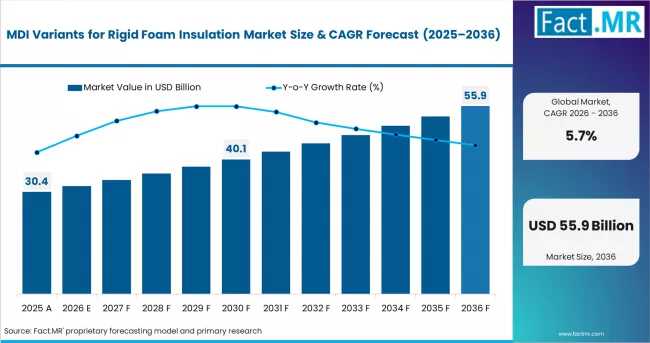
MDI Variants for Rigid Foam Insulation Market
Brazil infrastructure growth, cold chain expansion, and energy mandates are boosting demand for advanced insulation in industrial and construction sectors.
ROCKVILLE, MD, UNITED STATES, April 16, 2026 /EINPresswire.com/ -- According to Fact.MR’s latest analysis, the Brazil MDI variants for rigid foam insulation market is valued at approximately US$ 1.9 billion in 2026 and is expected to reach US$ 2.05 billion in 2027. The market is projected to grow to US$ 3.5 billion by 2036, expanding at a CAGR of 5.6%, with an incremental opportunity of over US$ 1.6 billion.Get detailed market forecasts, competitive benchmarking, and pricing trends: https://www.factmr.com/connectus/sample?flag=S&rep_id=14733
Brazil’s insulation market is undergoing a transformation driven by increasing investments in logistics infrastructure, cold storage facilities, and energy-efficient buildings. MDI-based rigid foams are gaining traction due to their superior thermal performance, making them essential for reducing energy consumption in tropical and high-humidity environments.
. Quick Stats
Market Size (2026): US$ 1.9 Billion
Market Size (2027): US$ 2.05 Billion
Forecast Value (2036): US$ 3.5 Billion
CAGR (2026–2036): 5.6%
Incremental Opportunity: US$ 1.6+ Billion
Leading Segment: Polymeric MDI-based rigid foam
Leading Region/Country: Brazil (Southeast region dominance)
Key Players: BASF SE, Covestro AG, Huntsman Corporation, Wanhua Chemical Group, Dow Inc.
Executive Insight for Decision Makers
Brazil is shifting toward performance-driven insulation adoption, especially in sectors where temperature control and energy efficiency directly impact operational costs.
Strategic Priorities:
Expand local production and distribution networks to reduce import dependency
Target cold chain, food processing, and logistics hubs
Invest in climate-resilient insulation solutions tailored to tropical conditions
Risk of Inaction:
Companies that fail to adapt to Brazil’s evolving energy efficiency standards and infrastructure growth risk losing share to global players with localized strategies and advanced product portfolios.
Market Dynamics
Key Growth Drivers
Rapid expansion of cold chain logistics for food exports and pharmaceuticals
Growth in commercial construction and warehousing infrastructure
Increasing focus on energy efficiency in buildings
Rising demand for temperature-controlled environments in agriculture and retail
Key Restraints
Dependence on imported raw materials and price volatility
Limited awareness of advanced insulation benefits in smaller projects
Regulatory challenges and compliance costs
Emerging Trends
Adoption of spray foam insulation in retrofit projects
Rising use of MDI foams in refrigerated transport and storage
Development of low-emission and eco-friendly insulation materials
Increased investment in industrial cold storage clusters
Segment Analysis
Leading Segment: Polymeric MDI dominates with over 58% share, driven by its durability and insulation efficiency
Fastest-Growing Segment: Cold chain insulation applications
Breakdown:
By Product: Polymeric MDI, Pure MDI
By Application: Building insulation, refrigeration, industrial insulation
By End-use: Construction, food & beverage, logistics, pharmaceuticals
Strategic Importance:
Cold chain and logistics sectors are becoming high-growth, high-margin segments, fueled by Brazil’s strong agricultural export economy.
Supply Chain Analysis (Critical Insight)
Value Chain Structure:
Raw Material Suppliers: Petrochemical firms supplying benzene, aniline, and derivatives
MDI Producers: Global chemical companies (primarily import-driven supply)
Foam Manufacturers: Local converters producing rigid polyurethane panels and systems
Distributors: Construction suppliers and industrial equipment providers
End-users: Builders, cold storage operators, logistics companies, food processors
Who Supplies Whom:
Petrochemical suppliers → provide feedstock to global MDI producers
MDI producers → export materials to Brazilian foam manufacturers
Foam manufacturers → supply insulation systems to construction firms and cold chain operators
Pricing Trends
Commodity Products: Standard MDI for large-scale construction
Premium Products: High-performance, low-emission insulation systems
Pricing Drivers:
Exchange rate fluctuations impacting imports
Raw material cost volatility
Demand from logistics and construction sectors
Certification and compliance requirements
Margin Insight:
Premium insulation solutions are gaining traction, offering higher margins in industrial and cold chain applications, where performance outweighs cost sensitivity.
Regional Analysis (Within Brazil)
Key Growth Regions:
São Paulo (6.0% CAGR): Industrial and logistics hub with high construction activity
Minas Gerais (5.7% CAGR): Growth in manufacturing and warehousing
Rio de Janeiro (5.4% CAGR): Infrastructure and commercial projects
Paraná (5.8% CAGR): Strong agricultural and cold storage demand
Rio Grande do Sul (5.6% CAGR): Food processing and export-driven logistics
Insights:
Southeast Brazil: Dominates due to industrial concentration
. Competitive Landscape
The Brazil market is moderately fragmented, with global leaders competing alongside regional distributors and converters.
Key Players:
BASF SE
Covestro AG
Huntsman Corporation
Wanhua Chemical Group
Dow Inc.
Local insulation system providers
Competitive Strategies:
Strengthening distribution networks in key states
Offering customized insulation solutions for tropical climates
Partnering with construction and logistics companies
Strategic Takeaways
For Manufacturers:
Localize production to reduce costs and improve supply reliability
Focus on cold chain and industrial applications
For Investors:
Target companies aligned with Brazil’s infrastructure and export growth
For Distributors/Marketers:
Highlight energy efficiency, durability, and ROI benefits
Future Outlook
Brazil’s MDI insulation market is set to benefit from long-term infrastructure investments, export-driven cold chain expansion, and rising energy efficiency awareness. The adoption of sustainable materials and advanced insulation technologies will further accelerate market growth.
Conclusion
Brazil presents a high-potential growth landscape for MDI variants in rigid foam insulation. As the country strengthens its logistics and construction sectors, demand for advanced insulation solutions will continue to rise. Companies that invest in localization, innovation, and strategic partnerships will be best positioned to capture this opportunity.
Why This Market Matters
Brazil’s growing role as a global agricultural exporter and industrial hub makes efficient cold chain and infrastructure systems critical. MDI-based rigid foam insulation enables energy savings, product preservation, and operational efficiency, positioning it as a key enabler of Brazil’s economic and sustainability goals.
Expanding technical support and application services
Southern Regions: Rapid growth driven by agriculture and exports
Emerging Regions: Increasing investment in logistics infrastructure
Key Insight:
Brazil’s supply chain is import-reliant, creating opportunities for local manufacturing investments and partnerships.
Full Report: Unlock 360° insights for strategic decision making and investment planning-
https://www.factmr.com/checkout/14733
To View Related Report:
Cold Insulation Material Market https://www.factmr.com/report/cold-insulation-material-market
Glass Insulation Market https://www.factmr.com/report/insulation-paint-and-coating-market
Active Insulation Market https://www.factmr.com/report/2521/hot-insulation-materials-market
Busbar Insulation Films Market https://www.factmr.com/report/soft-insulation-adhesives-market
S. N. Jha
Fact.MR
+1 628-251-1583
email us here
Legal Disclaimer:
EIN Presswire provides this news content "as is" without warranty of any kind. We do not accept any responsibility or liability for the accuracy, content, images, videos, licenses, completeness, legality, or reliability of the information contained in this article. If you have any complaints or copyright issues related to this article, kindly contact the author above.
